
- 21. April 2026
Second EASI ZERo Academy workshop explores policy and certification pathways for low-carbon construction materials
The latest EASI ZERo Academy workshop brought together experts and participants from across the construction sector to discuss how low-carbon and bio-based construction materials can move from innovation to wider market uptake.
The session focused on two connected themes:
- The EU policy framework shaping the future of construction products,
- The certification pathways needed to demonstrate performance, and support market access.
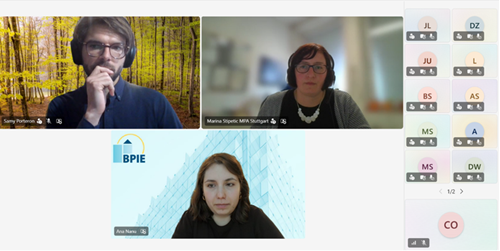
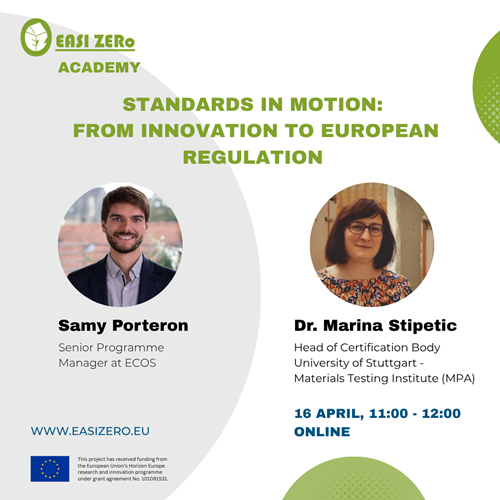
With presentations from Samy Porteron (ECOS) and Dr. Marina Stipetic (University of Stuttgart) the workshop offered both a policy overview and a practical perspective on certifying innovative materials such as those being developed in the EASI ZERo project.
Keep reading to get the detailed overview of the session, or watch the recording back here
EU policies are raising the bar for sustainable materials
In the first presentation, Samy Porteron outlined the main EU policies and standards affecting building envelope and bio-based materials.
A key focus was the revised Construction Products Regulation (CPR, 2024), which strengthens environmental sustainability requirements at product level. Manufacturers will increasingly need to provide information on life-cycle impacts such as carbon emissions, resource use and potentially hazardous substances. Over time, environmental information is expected to become more embedded in the technical specifications used for CE marking, with Digital Product Passports playing a central role.
The workshop also explored the Energy Performance of Buildings Directive (EPBD, 2024), which is pushing for higher-performing building envelopes as the EU moves towards zero-emission buildings. This is particularly relevant in the context of the Renovation Wave, where upgrading poorly performing buildings will require effective and reliable renovation solutions. Participants also learned that life-cycle assessment is becoming increasingly important for new buildings, with potential implications for future material choices.
At the same time, implementation remains a challenge. While the EU framework is advancing, national transposition is still ongoing, and current developments suggest uneven levels of ambition across EU Member States.
Another emerging framework discussed was the EU Carbon Removal Certification Framework (CRCF, 2024). Unlike the CPR or EPBD, the CRCF does not regulate products directly, but creates a voluntary certification system for carbon storage. This could become relevant for bio-based materials that store carbon over long periods, potentially creating new market incentives in the future.
Certification as a pathway to market uptake
In the second part of the workshop, Dr. Marina Stipetic focused on certification pathways for low-carbon materials and the practical steps needed to bring innovative products to market.
Certification can follow national or European routes depending on the product and its intended use, but in all cases it requires a structured process involving product testing, product assessment and certification. Typical tests include mechanical performance, thermal conductivity, fire behaviour, dimensional stability and ageing.
For innovative materials, however, additional testing is often needed. Dr. Stipetic illustrated this with examples of EASI ZERo products, such as bricks filled with phase change materials (PCM) and mycelium-based insulating panels, which may require further assessment of characteristics such as thermal behaviour, fire performance, acoustic properties, bond strength, VOC emissions, durability and resistance to damage.
A particularly interesting point raised during the discussion was the potential role of third-party certification. Even when it does not replace CE marking, it can help demonstrate added value and provide an extra level of confidence for customers, designers and specifiers. For innovative products that people have limited experiences with, this kind of independent assessment can play an important role in building trust and supporting market uptake.
From innovation to application
A key message from the workshop was that bringing low-carbon materials to market is not only a question of technical innovation. It also depends on clear rules, credible testing, appropriate certification pathways and consistent implementation of policy frameworks.
For the EASI ZERo project, these discussions are especially relevant. As new solutions for building energy renovation are developed, understanding how they can meet regulatory requirements and gain market acceptance is essential for ensuring real-world impact.
We would like to warmly thank Samy Porteron and Dr. Marina Stipetic for their valuable contributions, and all participants for joining the discussion.
Stay tuned for more updates from the EASI ZERo Academy and upcoming opportunities to explore the future of sustainable materials in building renovation.
Click here to watch the recording of the session